

Guides
Sponsor Marketplace Outreach: How Membership Communities Find and Land Sponsors
How membership communities source sponsor prospects, qualify them, structure the pitch email, and price the deal from a marketplace listing to a signed contract.
What to take away
Sponsor marketplace outreach for membership communities is a pipeline: source named prospects, qualify them against a checklist, then run a fixed follow-up sequence.
- The best sponsor prospect list comes from your own membership: industries, job titles and the tools members already pay for.
- A pitch email carries four things onlythe audience, the placement, the price and one clear next step.
- Benchmark sponsorship revenue from your own reach and past deal sizes before you quote a number.
Where sponsor prospect lists start
Start with your own roster. Pull job titles and company names from the member directory, then sort them by industry. The industries with the most members are the ones most likely to sponsor.
Then add brands that already pay for attention in your niche. Newsletter sponsors, podcast advertisers, conference exhibitors and trade publication advertisers are spending money right now.
Watch who sponsors the events your members attend. A brand already paying for that room will pay for your room too, once you can show a similar audience.
Before you rebuild that list by hand, it pays to know serious sponsor marketplaces that pair communities with buyers. Passionfroot, Swell, and Passerby connect creators and communities with brand sponsors; Impact.com handles larger partnership deals and affiliate-style sponsorship contracts.
Buyer expectations shift every cycle, so read the membership community trends your own members report before you commit to a multi-year package.
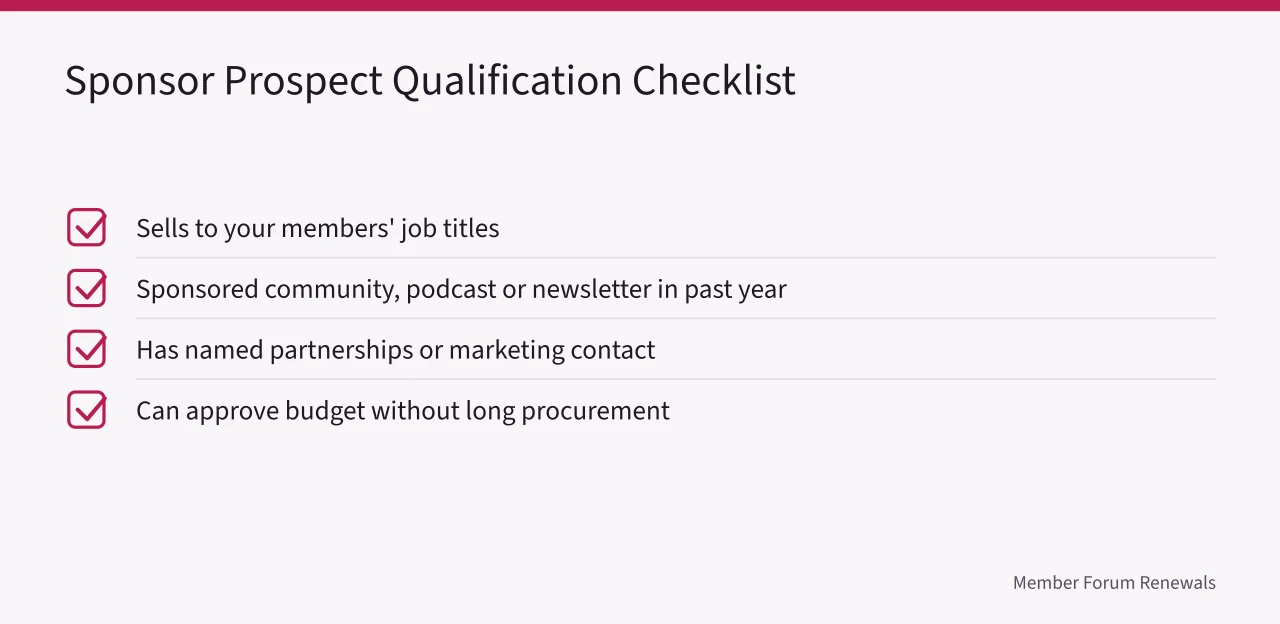
Qualify every name against a short checklist. A prospect that fails two lines goes onto a watch list instead of into the sequence.
- Sells to the job titles your members hold
- Has sponsored a community, podcast or newsletter in the past year
- Has a named partnerships or marketing contact
- Can approve a budget without a long procurement cycle
Who to contact inside the sponsor
Partnerships managers own community budgets at most consumer and software brands. Community leads and developer relations managers hold them at technical companies.
Find the name on LinkedIn, in a press release, or on the sponsor's own event page. Cold pitching a generic info@ address rarely reaches the person who can sign.
Example sponsor outreach sequence
One inbox and one shared spreadsheet are enough to run this sequence.
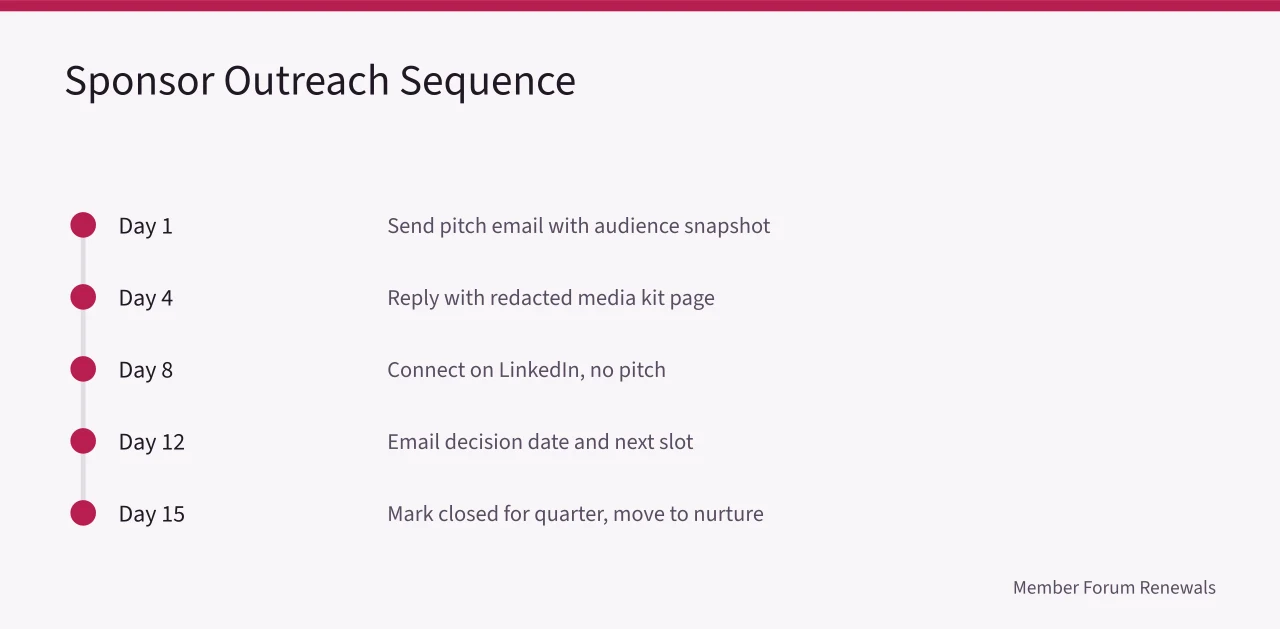
- Day 1Send the pitch email with an audience snapshot and one placement option.
- Day 4Reply in the same thread with a redacted media kit page or a sample placement.
- Day 8Connect on LinkedIn with a short note, no attachment and no pitch.
- Day 12Email a decision date and name the next open campaign slot.
- Day 15Mark the prospect closed for the quarter and move it to a nurture list.
If a payments or fintech brand sells into Latin America, expect questions about how you handle Miami cross-border membership renewals before anyone signs.
Sponsor pitch email structure
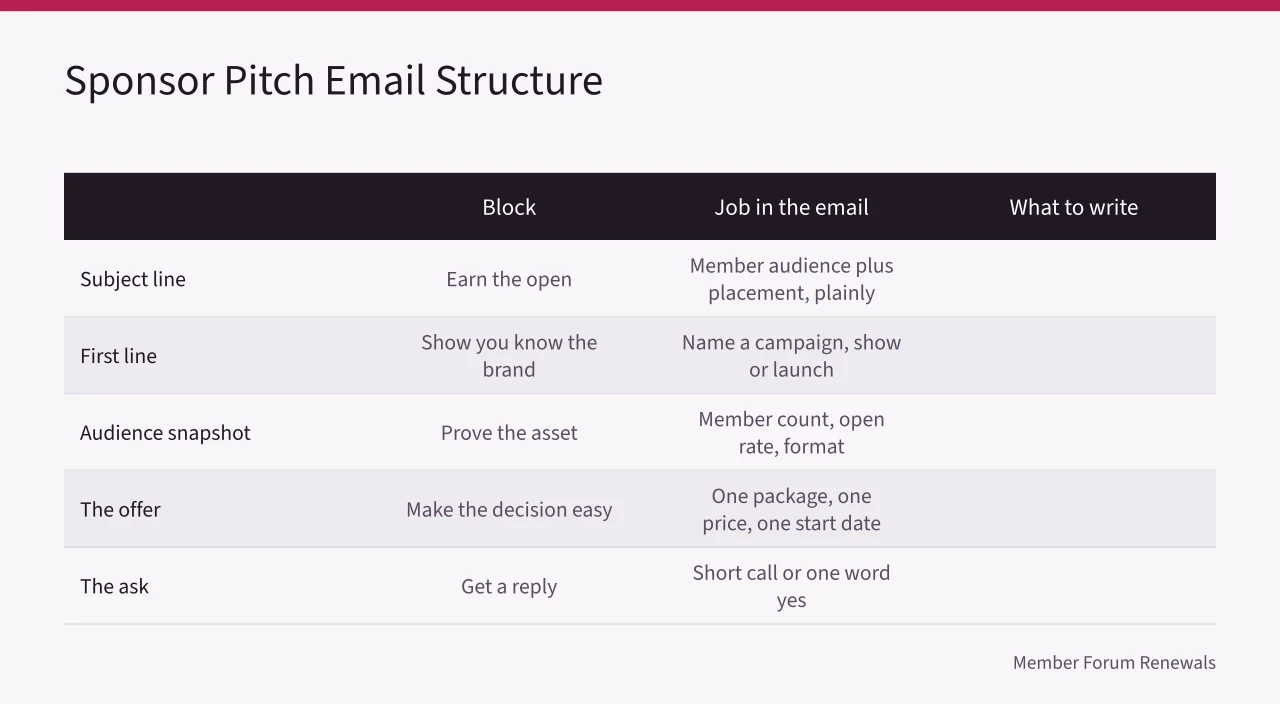
| Block | Job in the email | What to write |
|---|---|---|
| Subject line | Earn the open | The member audience plus the placement, stated plainly |
| First line | Show you know the brand | Name a campaign, show or launch you saw |
| Audience snapshot | Prove the asset | Member count, open rate and the format you sell |
| The offer | Make the decision easy | One package, one price, one start date |
| The ask | Get a reply | A short call or a one word yes |
Pricing and sponsorship revenue benchmarks
Communities usually price in one of two ways: a flat fee per placement, or a rate per thousand impressions. Flat fees are easier to sell and easier to forecast across a year.
Value the sponsor across the whole relationship instead of one campaign. A brand that renews three times is worth far more, which is why customer lifetime value is the right frame when you set a price.
Build a one page media kit from your own analytics: newsletter open rates, page views, event attendance and the names of past sponsors. Refresh it each quarter so the numbers stay current.
Track sponsorship revenue as a share of total revenue and as revenue per member. Watch both monthly, because a strong quarter can hide a weak category.
With no deal history, quote a floor price and offer a single trial campaign. Say what you measure rather than what you hope.
Follow-up, compliance and records
Outreach email in the United States needs an accurate subject line, a physical postal address and a working opt-out. The FTC CAN-SPAM compliance guide lists each requirement.
Canadian prospects fall under CASL, which sets consent and unsubscribe rules for commercial messages. The official text of the Act is worth reading once before your first Canadian send.
Log every touch in your CRM the same day, including the ones that went nowhere. A free HubSpot pipeline or a shared Airtable base works at the size most communities operate at. A sponsor who declines this quarter is often the fastest yes next year.
Sponsorship is not a favor you ask for. It is a paid placement with a defined audience and a measurable result.
Tracking sponsorship delivery and renewals
After the signature, send a one page schedule with dates, formats and the contact who owns each placement. Deliver a short performance report within a week of the placement going live.
Start the renewal conversation while the campaign is still running. Sponsors renew when the report arrives before the invoice, not after.
Keep a simple table of sponsor, start date, value and renewal date. Review it in the same weekly meeting where you review member churn.